The Electronic Intifada 2 December 2025
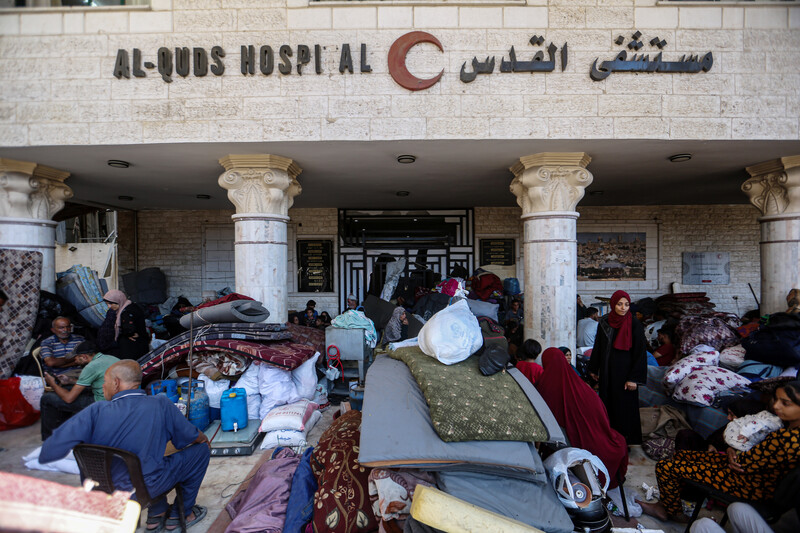
Displaced people sit on the ground outside Al-Quds Hospital in Gaza City’s Tel al-Hawa neighborhood on 16 September. Hospitals have become shelters for those seeking safety from Israeli attacks, but this leads to overcrowding and can cause disputes among the desperate.
APA imagesIt is one of the worst things to be told in Gaza today: You need surgery.
But that was the reality I faced back in May as the summer heat began to set in. It had started as a small pain in my leg that I consciously ignored for as long as possible. Until I couldn’t.
Four days after the first onset of symptoms, and with ever-increasing pain from the swollen, sore spot on my lower leg, I sought help. UNRWA provides online medical help and I connected with a doctor via WhatsApp.
Her response disturbed me. She presented several possibilities for what was causing the pain, including the bacterial infection that was causing the abscess that it turned out to be. They all required immediate surgical intervention.
It was the worst news. Surgery during genocide. How?
I begged the doctor to assure me that there was a chance I wouldn’t need surgery, but she did not mince her words. She said it was very likely that antibiotics would not work but urged me to get diagnosed directly.
I told my family that I might need surgery. Everyone understood the gravity of my situation. At first silence reigned, as I talked, my voice nervous and hoarse. Then my relatives did what relatives do and tried to reassure me that medicine would probably be enough and that I shouldn’t worry too much.
The next day, on 19 May, I went to a doctor at the Patient’s Friends Benevolent Society Hospital, a government hospital in Gaza City. She prescribed strong antibiotics as expected. She warned me, however, that if any pus should start to ooze it meant the infection had spread and I would need surgery.
The three pills I managed to obtain – this was after Israel had closed all crossings for months and medicines were becoming scarce – set me back $12. Though this was roughly the normal pharmacy price, it would have been free from the hospital before the genocide.
That same day, however, the inflammation got worse. Pus started to ooze from a small break in the skin. The smell was repulsive.
I had to face reality.
Reality
The reality in Gaza is that Israel has decimated the medical sector over the past two years.
According to the UN in October, and after the ceasefire came in, just 34 percent of “health service points” – that is hospitals, clinics, field hospitals, primary health care centers, etc. – are still functioning in Gaza.
The Israeli military has killed over 1,700 health workers.
Needing surgery is a lottery. Finding a hospital, finding qualified staff, finding medicine. All a lottery.
I had to make sure. The next day I decided to consult a specialist surgeon. I went to Al-Sahaba Medical Complex, a private clinic in the al-Jalaa’ neighborhood of Gaza City and managed to make a same-day appointment with Dr. Muhammad al-Ghaliz, who had extensive experience.
His verdict was unequivocal. I needed urgent surgery before the infection spread further.
“What’s your name? How old are you? What’s your mobile number? Do you have any chronic diseases?”
So many questions. Then: “Tomorrow, God willing, 21 May. Your surgery is at 8 am. Please come early so we can do some tests, and don’t eat or drink for 12 hours. From 7 pm, don’t take anything into your stomach. Don’t worry, this is a simple operation.”
We left the hospital with the surgeon’s words still ringing in my ears. Despite all my miserable attempts to adapt and prepare myself, I was shocked at the speed things were moving.
Tomorrow.
On our way back, a house was bombed close to us. I ran to hide in a nearby alley. Just another day in Gaza.
Surgery
The next morning, I packed my bag. I was fearful. When I got to the hospital I did the routine tests, blood pressure, sugar levels, heart rate and so on.
My pulse was racing. The nurse laughed when she saw my heart rate never going below 100. “Calm down,” she said, trying to reassure me.
I was taken to the operating room, all white: white ceiling, white floor, white bed, white equipment and nurses in white uniforms. I didn’t like it at all. It smelled sterile.
The nurse started chatting with me. She saw my nervous, yellow face and noted my pulse. It was while she was talking to me, distracting me, that another nurse injected the anesthetic – rationed in Gaza at the time solely for surgeries that required a patient to be fully unconscious.
I woke up to terrible pain in my leg. My vision was blurred and my head and all my limbs felt heavy. I couldn’t move. I felt a needle pierce my hand, and the soft voice of another nurse: “You’ve woken up early. Thank God you’re safe.”
She gave me a strong painkiller. The pain began to subside gradually until, after half an hour, I was able to move my head a little and then, slowly, my limbs.
I heard my mother’s worried voice.
“You’ve been in surgery for a long time, and I’ve been praying that there won’t be any bombings.”
My mother filled me in. There had been a missile attack on the Kamal Adwan Hospital in the north while I was in surgery. Panicked doctors had evacuated patients in their beds, and my mother feared the same would happen here because a couple of missile strikes had landed nearby.
Another day in Gaza during genocide.
Before going home, I was advised to focus on my recovery. A healthy diet, I was told, and constant cleaning of the wound.
Cleaning? At the time, my family and I were still living in our own home, though it was really more of a shell of a building. We had little left by way of furniture, all windows had been blown out, the roof was riddled with holes and most of the walls had been damaged in Israel’s incessant, indiscriminate bombings.
As for healthy food, at that point in May, no meat or poultry had entered Gaza in two months. There were some varieties of vegetables and fruit in the market, but they were all expensive.
It is no surprise that by October, an estimated 55,000 children in Gaza suffered acute malnutrition.
So I had very few options. Although I hate spicy food, I remembered that in elementary school, we used to be given green chili peppers because it is high in vitamin C. Vitamin C, in turn, helps heal wounds. This is all I could get but it proved really beneficial.
Life of a patient
A week after the surgery, I went back to the surgeon who told me the dressing on the wound would need to be changed every day for a month to help speed up healing.
That meant I would have to come to a hospital every day for a month. In Gaza, under genocide, that’s easier said than done.
Luckily, there is a Red Crescent hospital near our house, Al-Quds Hospital. Every day, I would leave the house at 8:30 am in order to arrive at 9. I would line up, take a number and typically wait two hours or more for my turn.
Though changing of the dressing would only take minutes, I would rarely get home before 1 pm.
After two weeks, even that routine had to change. I arrived at the hospital at 9 am, but there had been a shelling nearby and the hospital was filled with the wounded and the dead.
My session got suspended that day and the following three. In the end, I was forced to find another clinic.
One month turned into two, and I still needed my dressing changed daily.
One time, I went to a temporary field health center near the sea, an area known for danger. While I waited, I heard the sound of a very loud explosion. The shelling was clearly close to us.
Everyone ran downstairs immediately, all the patients, all the medical staff. Dust filled the air and ash obscured my vision. I could make out an old man walking heavily, who was completely covered in blood that seemed to come from a head wound.
Young men with yellow faces were carried on shoulders. A boy, perhaps about 15, looked sadly at what was left of his leg beneath the knee. He knew, as anyone who saw it knew, that it would be amputated.
I returned home in shock, again without changing my dressing.
This is what we endure as patients in Gaza under Israel’s genocide. Patients like Fatima, 45, whom I met at one clinic. She suffered a similar health problem to mine, but her husband had been martyred, and she was trying to care for six children while going daily to have her dressing changed.
Or Said, 17, who contracted an infection through contaminated water and a poor diet that caused his feet to fill with boils.
Pressure
For doctors and health professionals, it is worse. In addition to the direct danger they face as a result of Israel’s deliberate targeting of health care infrastructure, there is immense psychological stress.
Dr. Rami al-Sousi, who works in several hospitals, including Al-Sahaba hospital, told me that in addition to the physical danger, there is the daily, massive number of casualties, the lack of resources and the destruction to hospitals and clinics.
“The pressure is intense,” he said.
The presence of thousands of displaced people, who despite Israel’s targeting of hospitals and clinics, have chosen to shelter in or near such buildings, brings its own issues.
“The crowding causes problems,” he said, “and leads to disputes between people.”
As for surgery, there is little space for the wounded or their companions.
“We can’t find a bed to put a patient on. We can’t move people out because they have no homes to go to.”
Six months on, I still suffer infections. It’s better, but despite an enormous number of antibiotics, nothing feels resolved.
We also had to leave our home in Gaza City. My family and I are now in the south. The situation remains unsettled, and the so-called ceasefire has done little to ease our difficult situation.
But I have graduated university, even getting a very good grade in my field, science education. And even in this fog of pain and destruction, the next step is to pursue a postgraduate degree.
Israa Elholy is a writer from Gaza.