The Electronic Intifada 16 February 2026
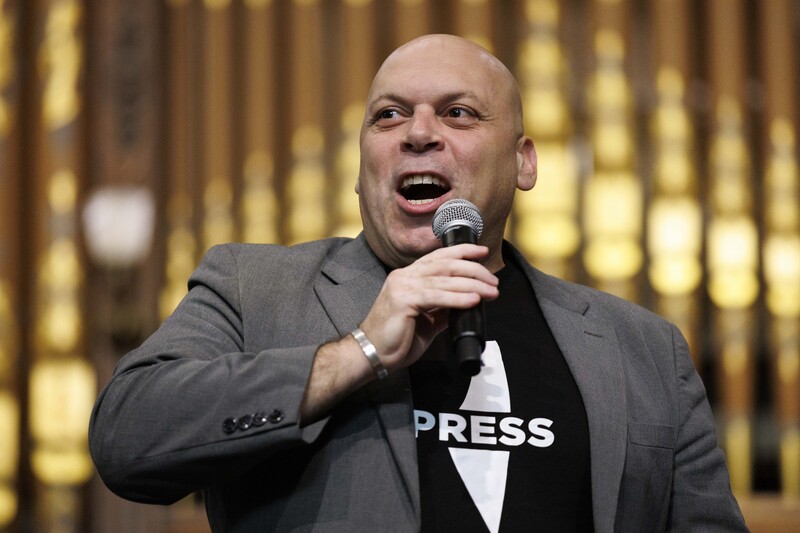
Comedian and lawyer Amer Zahr wears a “press” shirt to commemorate Shireen Abu Akleh, a Palestinian journalist killed by Israeli s in 2022. Zahr was performing at a benefit concert on 30 May, 2025 for the Portland, Oregon chapter of Palestine Children’s Relief Fund.
SIPA USAIn late December 2025, Israeli police detained Palestinian American comedian Amer Zahr shortly after his first of three performances in Nazareth, his hometown. He was questioned for an hour-and-a-half without any defined charges and was prevented from having his lawyer present.
When he was eventually freed, Zahr returned to the theater assuming the audience had left. To his surprise, they were still there, waiting for him. He took to the stage and performed the remaining shows as scheduled.
Zahr’s detention was not an isolated incident but part of a broader pattern in which Palestinians who speak publicly about Israel’s colonial violence – even as part of a comedy routine or on social media – are censored and targeted.
In February last year, Israeli authorities also raided the home of comedian Nidal Badarneh in Haifa and brought him in for questioning following an Israeli media incitement campaign that began when a popular program on Israel’s Channel 13 translated some of his jokes on its Instagram page.
In his performances, Badarneh pokes fun at Israeli hostages in Gaza and speaks about the ongoing genocide committed by Israel, as well as the structural inequalities and daily injustices Palestinians experience within the 1948 boundaries.
In the days following Channel 13’s translations, his social media accounts were flooded with hateful messages that included death threats and demands that he be displaced to Jordan. Several of his scheduled performances in the following days were canceled.
Badarneh was freed after a few hours and faced no legal consequences. But the purpose of his brief detention was clear: criticism of Zionist policies comes at a heavy price. Zahr later said he was threatened with administrative detention, or imprisonment without charge or trial, a common Israeli practice that is usually applied to Palestinians in the 1967 occupied territories. It is a type of detention that can last for several months and can be renewed indefinitely.
A mirror
Despite these colonial attempts at intimidation, Palestinian comedians, including Zahr, continue to return to the stage and perform. Indeed, the fact that Zahr’s audience waited for him on the night of his brush with Israel’s authorities, suggests that attempts to silence him or scare his fans have not succeeded.
Zahr, a lawyer by education, holds US citizenship and enjoys a certain amount of visibility and relative privilege compared to many Palestinians with no foreign citizenship. But his passport and his legal background did not protect him from Israel’s intimidation tactics. Zahr is, after all, also Palestinian, and for this reason his performances are treated as threatening.
Palestinian stand-up comedy mirrors the texture of everyday Palestinian life. On stage, comedians talk about everything from family dynamics, marriage and relationships, to gender roles and Arab cultural norms, as well as the frustrations that Palestinians have to deal with in their daily lives.
Woven into these stories are the realities produced by Israeli settler colonialism and its practices, including nighttime arrests, home raids, airport interrogations, endless waiting at checkpoints and encounters with the Israeli military. Not everything comedians talk about is explicitly political, but politics is always in the background.
An audience’s familiarity with that reality gives the comedy a political purpose. As Lisa Bhungalia claims in her essay “Laughing at Power,” stand-up comedy and the laughter it generates can be “transgressive” and work to “destabilize existing power relations and established hierarchies by calling into question the norms and ‘rationalities’ that underpin our social world.” Exposing Israel’s practices, contradictions and absurdities transforms what is imposed into something that can be named, questioned and publicly ridiculed.
However, in the Palestinian context, stand-up comedy is not limited to dismantling or mocking Israeli colonial power; it is also a space where alternative just futures can be imagined. In the essay “Taking Stand-Up Comedy Seriously,” authors Oskar Primbs and Marcelle C. Dawson urge us to pay close attention to stand-up comedy in settler-colonial contexts, where it can serve as a powerful site for truth-telling, public pedagogy and imagining decolonial futures.
The authors look at Indigenous stand-up comedy, such as Māori comedy, as counter-storytelling that “encourages critical reflection on ‘racethinking’ in ways that may inform debates on settler-colonial relations.”
Rather than looking at Indigenous communities as passive victims, in other words, comedy presents them as complex and politically engaged subjects.
Smile in the face of death
One of Zahr’s most famous jokes illustrates this power of comedy to subvert dominant narratives.
“They stole our land,” he says about Israel’s founding and the 1948 Nakba. “They took it fully furnished.”
Zahr’s joke addresses the Zionist propaganda of “a land without a people for a people without a land,” which has long been used to justify the forced displacement of Palestinians and the theft of their land, their homes and their properties. It’s a simple joke, and it lays bare the absurdity of the claim that Palestine was uninhabited.
Similar to the counter-storytelling of the Māori people, Zahr’s joke does not present Palestinians as passive victims or objects of pity, but rather as knowledgeable agents capable of mocking Israeli colonial logic and articulating instead their own indigenous narrative.
Zahr deploys a similar strategy in another joke, where he suggests that Palestinians should thank Jacob, the Jewish settler who told Muna al-Kurd in the Sheikh Jarrah neighborhood about her home: “If I don’t steal it, someone else will.”
Zahr does not intend this expression of gratitude to be genuine, of course, but rather a way to appreciate how Jacob exposes the logic of Zionist settler colonialism, where theft is treated as inevitable. He later takes this joke from stage into reality in a video posted on Instagram, where he visits Sheikh Jarrah and stands in front of the al-Kurd family’s home, sarcastically thanking Jacob. When Jacob asks him why he is thanking him, Zahr responds, “Thank you for being you … you’re amazing.”
Badarneh, meanwhile, was unfazed after his arrest.
“The Israelis cannot confiscate our right to anything, especially our right to smile in the face of death,” he said.
His words encapsulate the reality Palestinians face today and clearly reveal what is ultimately at stake. Israel continues to kill, arrest and intimidate Palestinians on a daily basis, while Gaza is subjected to an ongoing genocide in full view of the world that has claimed over 71,000 lives, with the real number likely much higher.
Yet even amid this unprecedented level of brutality, there remain limits to what Israel can control or confiscate. Laughter, satire and storytelling cannot be stolen.
In this sense, comedy is not a means of escaping politics. It is rather one of the tools Palestinians continue to use to affirm their presence and connection to the land and insist that their voices be heard in a reality that constantly seeks to erase them.
Mai Awad is a Palestinian PhD candidate at the University of California, Santa Cruz.
Tags
- Gaza genocide
- freedom of speech
- decolonization
- comedy
- indigenous resistance
- Amer Zahr
- Nidal Badarneh
- Log in to post comments