All Content

UNRWA Opens Nimreen Children's Music Centre in Yarmouk

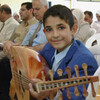
To the rhythms of classical Arab and Palestinian music, UNRWA Commissioner-General Peter Hansen today inaugurated the Nimreen Children’s Music Centre, which for the first time will provide professional music tuition on classical Arabic instruments to 40 gifted students from UNRWA elementary schools in Yarmouk. The children will be selected from a pool of more than 8,000 pupils in the age range 7-9 years, grades 3-5. The Centre, housed in a classroom in UNRWA’s Nimreen school revamped for its new purposes, is a small but well-furnished music studio, with sound and recording equipment, air conditioning and sound insulation. In Syria, UNRWA provides assistance to some 417,400 refugees. 

UN reports another 'bad month' in Middle East, calls for return to peace plan


With a marked increase in the number of casualties on both sides of the conflict, a resumption of suicide bombings, and no good news to report on the implementation of the “Road Map”, it had been a bad month in the Middle East, Under-Secretary-General Kieran Prendergast told the Security Council this morning. As had too often been the case in recent months, there was little positive and much discouraging to note and report, he said. Especially troubling was the continuing void in terms of an active peace process. Absence of hope for a peaceful settlement led to despair, strengthened extremists and was a sure recipe for continuing violence and instability. 

Unburied


“This week, as the survivors of the Sabra and Shatila massacre remember their dead, Ariel Sharon, the man deemed ‘personally responsible’ for the massacre by Israel’s 1983 Kahane Commission, is planning an official visit to Holland. When Ariel Sharon steps off the plane, he will be treading not only on Dutch soil, but also on the bodies of the dead of Sabra and Shatila. Legally, the massacre and its victims remain unburied. It is Holland’s shame to assume that rolling out a red carpet of welcome can cover the corpses of Mr. Sharon’s victims, whose number continues to climb with each passing day.” EI co-founder Laurie King-Irani remembers a massacre that many prefer to forget. 

Prisoner Stories: Sleiman Sari al Sa'di's sons


Less than a month after being released from prison, Omar al Sa’di was arrested at the Huwara checkpoint . The reserve sentence associated with his previous sentence means that he is guaranteed four years in prison no matter what. Two informers who are currently themselves in Israeli prisons have accused him of being the leader of a group opposing Israel, they themselves confessing to being part of that group. He is also accused of trying to fire in the air near an Israeli settlement and of trying to attack Israeli collaborators. His parents have a document in Hebrew specifying these accusations, but because they can’t read the language, they know only roughly where the names are in the document of those accusing him. 

Prisoner Stories: Mohammad Hussnee Zeidan


Ahmad Zeidan was only fifteen when his brother Mohammad (20) was arrested and imprisoned by Israeli forces in April of 2002. In his pocket, he keeps two passport-sized photos, one of his brother Mohammad and one of his cousin. Nicknamed Abu al-Baha’, Ahmad’s cousin (pictured right in one of Palestine’s ubiquitous martyr posters) was shot dead at the age of 22 in May this year in one of the frequent Israeli invasions of Jenin refugee camp that Israeli forces make to assassinate Palestinians accused of “terrorism” against Israel. In his billfold, Ahmad also keeps a letter written to the family by his brother from prison letting them know what had happened to him. It is penned carefully on a fragile silver-backed paper wrapper. 

Weekly report on human rights violations


This week Israeli forces killed 24 Palestinians, mostly civilians, including 6 children. Seven of the victims were killed in another extra-judicial execution. Israeli forces conducted a series of incursions into Palestinian areas in the West Bank and Gaza Strip. Israeli forces demolished 43 homes and dozens of donums of agricultural land were razed in the northern Gaza Strip. In Rafah three homes were demolished and in Mughraqa Israeli forces demolished seven homes. In the West Bank Israeli forces demolished two homes. Israel continued the construction of the Apartheid Wall and imposed a total siege on the occupied Palestinian territories. 

In Gaza, the dead bury the dead


On September 10, after an Israeli incursion into the northern Gaza Strip that had left at least five dead and dozens wounded, I went to a Gaza City cemetery to look for a young gravedigger. I had met Mossab, a slim 18-year-old boy from Gaza City, a week earlier. He had long ago dropped out of school to pursue a profession that appeals to very few people, but which is catering to more and more youngsters in Gaza. In the city’s Sheikh Radwan cemetery, Mossab, along with several other boys, was employed to dig, guard and take care of the graves of the men, women and children that pack the graveyard. 

Civil society meeting at UN seeks to end Israeli occupation of Palestine


A new draft plan in support of Palestinian rights adopted by a non-governmental conference committee meeting at the United Nations calls for escalating pressure on Israel to end its occupation and threatens to seek divestment, arms embargoes and other sanctions in the event of non-compliance. The “2004-2005 Plan for Action to support Palestinian rights through international law and the United Nations” was presented to the International Conference of Civil Society in Support of the Palestinian People on the last day of a two-day meeting at UN Headquarters in New York after being adopted by its Steering Committee. 

Conditions in Israeli prisons begin to normalize after strike


In her first visit after suspension of the hunger strike, advocate Buthaina Duqmaq paid a visit to Nafha Prison on 7 September 2004. Ms. Duqmaq met the prisoners’ representative Tawfic Abu-Na’im along with Omar Barghouthi, Issa Shabanah and Tareq Zaydan. Abu-Na’im affirmed negotiations with the prison administration are still on. Conditions began to normalize as the administration returned the electrical equipment it had confiscated earlier, extended the exercise period to one and a half hour and returned TV reception but restricted Al-Jazeera, Palestine Broadcasting Corporation (PBC) and al-Manar networks. The administration brought several inmates from solitary confinement back to common holding cells. 

Stories from Gaza


On the 8th of September, Israeli occupying forces made an incursion into the Jabaliya refugee camp - now home to 80,000 Palestinian refugees and their descendents for the past 56 years. The operation went on for three long days In the first few hours of the incursion 4 people were killed and tens of others were injured, many of them seriously. According to physicians who tended to the wounded the Israeli soldiers targeted the chest, abdomen and lower limbs, of boys who were throwing stones at the army tanks and bulldozers while they demolished homes and razed agricultural land. 30 houses were destroyed — 10 completely and 20 partially — which left at least 200 people homeless. The youngsters were protesting in their own way against the presence of the occupying forces in their town, some of them didn’t live to tell the tale.