All Content

ECHO: "Humanitarian needs in the West Bank and Gaza must not be forgotten"

The humanitarian situation in the occupied Palestinian territories must not be overshadowed by the latest political developments and requires renewed assistance by the donors’ community, warned Cees Wittebrood, Head of the Middle East and Mediterranean countries of the European Commission’s humanitarian aid department. The European Commission is one of the largest donors of humanitarian aid to the Palestinian population, with €155 million of assistance provided since the start of the second Intifada in 2000. 

Israeli-Palestinian peace climate vastly improved but threats persist, Security Council told


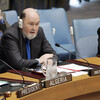
The political climate between Israel and the Palestinians has vastly improved in the past month with hopes for progress towards peace rekindled, but possible action by Palestinian groups and the continuing hardships of daily life in the occupied territories still cast a dangerous shadow, the top United Nations political officer said today. “We are convinced that 2005 is a year of opportunity,” Under-Secretary-General for Political Affairs Kieran Prendergast told the Security Council in his monthly briefing, citing the summit between Israeli Prime Minister Ariel Sharon and Palestinian President Mahmoud Abbas, the Palestinians’ vow to stop acts of violence and Israel’s pledge to cease military activities. 

Israel's Criminalization of Nonviolent Protest


14 February 2005 — According to Israeli authorities, one reason for my arrest two weeks ago in Biddu and my denial of entry into Israel in 2003 is that I “organized and participated in illegal demonstrations.” Israeli authorities frequently use the term “illegal demonstrations” to describe peaceful protests against Israeli government violations of international law. This twisted reasoning needs to be exposed and rejected. What is legal often does not completely correspond to what is moral. However, when what is moral is described as illegal, there is a major problem. 

The Republican Jewish Coalition and the pro-Israel Lobby


Most U.S. anti-war activists are opposed to the Bush Administration’s policy of using U.S. tax money to provide military weapons to various governments in the Middle East, including the Israeli government. But the Republican Jewish Coalition [RJC], which describes itself as “the sole voice of Jewish Republicans to Republican decisionmakers and the Jewish community” on its website [www.rjchq.org], promotes continued U.S. aid to the Sharon regime and favors an expansion of strategic cooperation between the U.S. government and the Israeli government. 

QUIT! premieres latest line of "Estee Slaughter" products on Valentine's Day


Queers Undermining Israeli Terrorism (QUIT!) premiered “Eternally Mine,” “a stench beyond occupation,” from Estee Slaughter at its Valentine’s Day Extravaganza at Macy’s Union Square in San Francisco. Eternally Mine joins Estee’s signature scent Occupation and Apartheid For Men in the group’s killer product line. QUIT! is targeting cosmetics giant Estee Lauder with its boycott Israel message, because heir Ron Lauder is president of the Jewish National Fund, which maintains and implements Israel’s discriminatory land policies. 

Palestine Through the Arts: A nation defined by culture not politics


The exporting of Palestinian art is particularly important because while the U.S., which can be considered a third party to the conflict, shares a sense of cultural identity with Israel, it holds very violent perceptions of Palestinians. When Americans see headlines and pictures of suicide bombings, they all too often make no distinction between Palestinians who blow themselves up at bus stops, Iraqi resistance fighters, and Al-Qaeda lunatics who fly planes into skyscrapers. Furthermore, it is only violent pictures that make the news — after all, if it bleeds it leads. 

A small but welcome step


The Israeli Committee Against House Demolitions (ICAHD) welcomes the decision of the Israeli Army to halt its policy of demolishing Palestinian houses either as punishment for acts of violence or as a deterrent measure. This policy constituted a clear violation of international law, both because it by-passed due process of law in cases where perpetrators were punished before being tried and because it constitutes collective punishment against the families of perpetrators who are innocent of any crime. 

Weekly report on human rights violations


4 Palestinians, including 2 children, were killed by IOF; IOF conducted a series of incursions into Palestinian areas; Houses were raided and at least 10 Palestinian civilians were arrested; Continued shelling of residential areas, and a Palestinian child was injured in Khan Yunis; Israeli settlers have continued to attack Palestinian civilians and property in the West Bank; Construction of the “annexation wall” in the West Bank has continued and more areas of Palestinian land were confiscated for this purpose in Jerusalem and Jenin; IOF have continued to impose a total siege on the OPT; IOF have continued to close a number of roads since the beginning of the current Intifada and Palestinians aged 16-35 have been prevented from traveling through Rafah International Crossing Point, and a number of Palestinian civilians were arrested at checkpoints. 

USAID proposes Palestinian company 'caretaker' for Gush Katif lands


One of the major questions facing Palestinians as the time nears for Israel to evacuate 17 Gaza Strip settlements and four more in the northern West Bank is the manner in which they will be transferred to Palestinians. Israel has so far refused to transfer the properties directly to the Palestinian Authority, and has not finalized which assets - houses, infrastructure and greenhouses - will remain. Palestinians have requested that Israel demolish all assets that do not fit into their planning needs, but Ministry of Planning officials admit that the Palestinian Authority itself is lagging terribly behind in developing scenarios for the withdrawal. 

Looking towards Palestine: Photographic projects in Madrid


“The work included in the photographic exhibit, ‘Looking towards Palestine,’ represented an impressive diversity of styles and subject matter, but the common denominator — appropriately, given the reality on the ground in Palestine — was the rubble. This is not to say that the photographers failed to explore other themes. On the contrary, the show was full of images of funerals, children’s games, Israeli tanks and bulldozers, living rooms, violent confrontations — in short, the stuff of daily life under occupation and in the diaspora. The rubble, however, was never far from view.” John Collins reports from Madrid.