All Content

Survey: 70 percent of Palestinian households need assistance

The Palestinian Central Bureau of Statistics conducted another round of the survey on the impact of Israeli measures on the economic conditions of Palestinian households. Data collection was conducted in the second quarter of 2004. The survey found that 226,000 Palestinian households lost more than 50 percent of their usual income and about 22.6 percent of Palestinian households in the Gaza Strip suffered from highly critical living conditions. The survey indicates that 59.7 percent of Palestinian households decreased their income during the Intifada of which 62.5 percent lost more than half of their usual income. 

Amnesty concerned about excessive use of force in Gaza


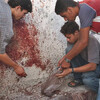
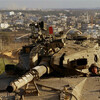
Amnesty International is concerned about the deterioration of the human rights and humanitarian situation as a result of the Israeli army incursion in the Jabaliya refugee camp and surrounding areas in the northern Gaza Strip, including sectors in the nearby towns of Beit Hanoun and Beit Lahiya. In the past week more than 70 Palestinians have been killed, more than a third of whom were unarmed and including some 20 children. Hundreds of others have been injured. The Israeli army has repeatedly used excessive force, including heavy shelling from tanks and helicopter gunships. Experience has shown that the use of such weapons in densely populated residential areas, invariably results in a high rate of death and injury of bystanders and people who are not involved in armed confrontation. 

United States vetoes Security Council text demanding Israel withdraw from Gaza


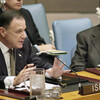
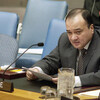
The United Nations Security Council today failed to adopt a resolution that would have demanded Israel halt all military operations in northern Gaza and withdraw from the area. The United States vetoed the draft, which received 11 votes in favour, with Germany, Romania and the United Kingdom abstaining. Speaking prior to the Council’s vote, Ambassador John C. Danforth of the United States called the proposed text “lopsided and unbalanced” for containing many “material omissions” and said it deserved a no vote. The Permanent Observer of Palestine, Nasser Al-Kidwa, called today another “sad day” for the Security Council for its failure again to fulfil its responsibility in maintaining international peace and security. 

Gaza Daily Update, 7.00 PM


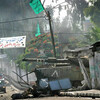
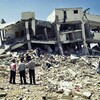
Israeli forces continued their large scale military assault on the northern part of the Gaza Strip. According to initial documentation, Israeli forces destroyed 168 homes, at least 38 of which completely. Since its military assault on 28 September, Israeli forces killed 77 Palestinians, including three who were killed in southern Gaza during the same period and 24 children. At least 248 were wounded, including 81 children. Israeli forces continue shelling and air attacks with missiles. The civilian population suffers from lack of food, water and medicines. In the south of Gaza, four years old Lu’ay An Najjar was killed by Israeli forces. He was shot in the head near his home. 

Security Council considers resolution on Israeli military actions (2/2)


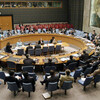
While some in the international community were trying to breathe life into what seemed to be a dying peace process in the Middle East, Israel had unleashed its military, sowing death and destruction in Gaza, the Security Council heard today as it met in the wake of escalating deadly violence in the Gaza Strip. The emergency meeting was in response to a week-long Israeli military incursion into the Gaza Strip that has left 83 Palestinian dead and many more wounded, following rocket attacks against Israeli targets by Palestinian militants, which killed two Israeli children. Most of the 29 speakers today warned that the recent violence had imperilled the hope for peace, with many urging both sides to give up the violence and return to their obligations under the Road Map. 

Security Council considers resolution on Israeli military actions (1/2)


While some in the international community were trying to breathe life into what seemed to be a dying peace process in the Middle East, Israel had unleashed its military, sowing death and destruction in Gaza, the Security Council heard today as it met in the wake of escalating deadly violence in the Gaza Strip. The emergency meeting was in response to a week-long Israeli military incursion into the Gaza Strip that has left 83 Palestinian dead and many more wounded, following rocket attacks against Israeli targets by Palestinian militants, which killed two Israeli children. Most of the 29 speakers today warned that the recent violence had imperilled the hope for peace, with many urging both sides to give up the violence and return to their obligations under the Road Map. 

Current violence pushing Gaza into a humanitarian crisis, UN agencies warn


The ongoing violence in Gaza, on top of the sharply deteriorating humanitarian situation this year, is pushing the Palestinian population into a deep crisis, a dozen United Nations aid agencies working in the region warned today. They called on the Israeli Government to guarantee humanitarian agencies unrestricted and secure access into Gaza for both personnel and relief supplies, ensure the free movement of humanitarian goods and personnel within the territory, and respect its obligations under international humanitarian law by ensuring the safety of the Palestinian civilian population. 

Judging the Intifada


The fourth anniversary of Israel’s violent crackdown on the Palestinian uprising, which coincided with its latest massacre of Palestinians in the Gaza Strip, occasioned a number of analyses, many concluding — wishfully — that the Intifada has been “counterproductive” for the Palestinians, or even a “failure.” But EI contributor Hasan Abu Nimah and co-founder Ali Abunimah argue that Israel remains at a strategic dead end, while Palestinians on the ground are unbroken and Israel is far from victory. The is a danger that Israel, unable to escape from this predicament, may seek to spread the conflict to its neighbors. 

The 1992 El Al Bijlmer crash: a cover-up of a chemical inferno?


“Twelve years ago, an El Al Boeing airplane carrying military cargo crashed into an apartment building in the Bijlmer neighbourhood of Amsterdam. Forty-three people directly lost their lives. More people have died since then, and many are still suffering from unidentified diseases. The Dutch government denies any connection between health ailments and the disaster, though hundreds of people inhaled poisonous smoke from the burning airplane and the apartment building. Some of the El Al plane’s cargo is still unknown, but three of the four components of sarin nerve gas were present at the crash site.” Lizzy Bloem reports for Electronic Intifada from Amsterdam 

The myths and reality of Palestinian refugees in Syria: An interview with Lex Takkenberg


Syria is a country that few people in the West know much about, or care to visit. After all, this is one of the countries that George W. Bush declared part of the “Axis of Evil.” But when I travelled to Syria for the first time, I could not find anything “evil” about it. Indeed, I did not find anything “evil” in the way Syria treats Palestinians who were forced to flee their homeland in 1948; and after my interview with Lex Takkenburg, Deputy Director-General of the U.N. refugee agency for Palestinian refugees (UNRWA) in Syria, I concluded that “compassionate” would be a more accurate description of Syria than “evil.”