All Content

Five days of struggle against Israel's West Bank Barrier

With the resumption of construction of the separation wall a familiar pattern repeats itself. Negotiation is not even attempted, and Israeli policy is set unilaterally by the army and government without consideration for Palestinians. At the same time, every attempt at protest and nonviolent resistance is repressed violently. In the course of the last five days (September 19-23) the occupation forces returned to their attempt to literally cement their existence on Palestinian lands. Naturally the residents of the affected villages resisted this attempt and we are with them. Our method and our aim, which we have declared and consciously acted on for the last two years, are popular nonviolent struggle. 

Despite lack of progress, Quartet reaffirms support for Road Map


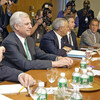
The members of the diplomatic Quartet, meeting today at United Nations Headquarters in New York, pledged support for the Road Map outline peace plan despite the lack of “significant progress” achieved so far. In a statement released after their meeting, the representatives of the UN, European Union, Russian Federation and United States called on Israel and the Palestinians to do more to bring peace to the region, including living up to obligations outlined in the plan. “The situation on the ground for both Palestinians and Israelis remains extremely difficult and no significant progress has been achieved on the Road Map.” 

Western Massachusetts Palestinian Film Festival to be held October 1-3


A three-day festival, “Aqoolu Lakum - Let Me Tell You: The Western Massachusetts Palestinian Film Festival,” will take place in the Pioneer Valley on October 1-3, 2004. The festival, organized by Valley residents from a range of backgrounds, will include twenty-six films and an exhibition of rare photographic material. The festival will show a mixture of documentaries and fiction films about Palestine made largely by Palestinians, with a selection by Israeli and other international filmmakers. 

Interview with Afif Safieh, Palestinian General-Delegate to the UK and the Holy See


As new Labour, the Liberal Democrats, and the Tories prepare for their party political conferences in Bournemouth and Brighton in the coming weeks, Palestinians from Balata to Beit Jibrin will be locked up in their homes and refugee camps for the fourth consecutive year. Against this background, occasional EI correspondent Victor Kattan interviewed Afif Safieh, the Palestinian General-Delegate to the UK and the Holy See - a sophisticated and suave chain-smoker - who invariably describes himself as a diplomat, a democrat, a political scientist and an observer of the British domestic political scene. 

The Lion Kings of Qalqilya


THE KINGS of peace” is how Saeed Daoud, director of the Qalqilya Zoo, describes the three lions, Jafer, Jaras and Naboko who have recently settled into their new home in the West Bank along with two zebras and a deer. On September 5, the animals were moved from the Ramat Gan Safari Park just outside Tel Aviv to Qalqilya after the Israeli safari park announced plans to help rebuild Qalqilya Zoo by providing it with a number of animals. The zoo has been ravaged by four years of Intifada, with several animals dying and a dramatic drop in the number visitors. The zoo, the only one of its kind in the West Bank, was built in 1986 and is currently home to almost 170 animals. 

"A state cannot indefinitely stand against the world": An interview with UN Special Rapporteur John Dugard


“There is no possibility of sanctions being imposed against Israel; at least at present. South Africa alienated itself from all five of the veto powers and this allowed limited sanctions to be imposed. Israel will, it seems, for ever have the USA to veto any sanctions being imposed by the Security Council. I raised the issue simply to get it into the debate so that it is on the table. I have had no feedback whatsoever.” Occasional EI contributor Victor Kattan recently interviewed John Dugard, U.N. Special Rapportuer for Human Rights in the Occupied Palestinian Territories. 

UN Conference on Palestine Sets Stage for UN General Assembly


Nearly 100 Heads of State and Government convened at United Nations Headquarters in New York today as the General Assembly opened its annual high-level debate on global issues. Decrying what he described as “shameless” disregard for the rule of law around the globe, Secretary-General Kofi Annan urged world leaders gathered at the General Assembly to do everything within their power to restore respect for the fundamental principles of law – in domestic affairs, as well as on the international arena. What has irked Kofi Annan is that the rule of law has been seriously eroded since September 11, and in the case of Israel, long before. Genevieve Cora Fraser reports. 

Fear of flying


Two days after a flight carrying former pop star Cat Stevens was diverted from Washington, DC to Maine, where the 1970s pop idol, now known as Yusuf Islam, was removed from the plane and sent back to London, and one day after a flight in Wisconsin was forced to turn around after a passenger opened the inflight magazine and found scribbled words in an “Arabic style writing,” another US flight was interrupted after a passenger grew suspicious of a man sitting next to him. The flight was grounded for six hours as security teams searched the aircraft and questioned all passengers. BNN’s Loreh Al-Malakeh reports. 

UNCTAD stresses vital role of small-, medium-sized enterprises in rehabilitation of Palestinian economy


Unless immediate action is taken to improve the supply capacity of small and medium enterprises (SMEs), the Palestinian economy will be effectively transformed into one of subsistence, warns a new UNCTAD study.  The study notes that the protracted conflict in the occupied Palestinian territory has generated profound structural distortions and changes in the functioning of these enterprises that are unlikely to be reversed once political stability is achieved. It examines the SMEs’ contribution to economic growth by shedding light on their life cycle and the factors influencing their establishment, survival, growth and decline before and after the ongoing crisis. 

Liberation Art of Palestine


Samia Halaby was twelve-years-old when Israeli soldiers arrived in Jerusalem. Born in the midst of Palestine’s bloodiest uprising against British occupation, Halaby was no stranger to colonial oppression, but something was different this time. She sensed it in the indescribable arrogance a British soldier used when he searched her school bag: His expressions, his motions, were the presage of a storm. As a Palestinian artist, Halaby’s work is, intrinsically, cultural resistance. Compared to many of her contemporaries, her circumstances have been rather fortunate. Following several years of exile in Beirut, her family moved to the U.S., where Halaby studied Cubism, Soviet Constructivism, American Abstract Expressionism and the Mexican Mural Movement.